I don't know where these trains of thought come from, but lately I've been on a tear about voting rights. So, this information from Agenda for Justice caught my eye. The European court of human rights declared that denying prisoners the right to vote violates the European Convention on Human Rights. This ruling affects 46 countries, and of course the United States isn't one of them.
Not that we care in the slightest what other countries do, anyway. Nor, of course do we have anything to learn from anyone else (turning sarcasm off now.)
In the United States we have 2 million people in jail. Many states (13, actually) continue to deny voting rights to convicted felons long after their sentences are served -possibly another 2.5 million people. Check out your state here: Right to Vote. These numbers create a staggering reduction in the number of people eligible to vote, and, it seems to me, a corresponding reduction in legitimacy of anyone elected.
It gets even more tangled. A recent study suggests that Latinos are more likely than the general population to lose the right to vote due to felony disenfranchisement laws. Moreover, states with high non-white populations are the ones most likely to adopt restrictive re-enfranchisement laws. And we already know about the racial statistics of who's in jail. Does anyone see a pattern here? It's not hard to spot.
So, what do we do? I need to learn more before I do anything, so that's my commitment. But, here are some general ideas. I got a great deal of this information from The Sentencing Project. One can sign up to get advocacy information, which is what I will do. And, if there's a grad student out there looking for a research project, they also offer small research stipends. The link is a pdf file, but here it is: Research Grants
Monday, October 31, 2005


Sunday, October 30, 2005
Still More in the Surreal Department
I feel like I've lost my blogging "voice" a little bit lately. What I want to do is muse about ways to make things better. I want to be part of that small thoughtful group changing the world. What I am doing is spending all my time sputtering in amazement at the craziness around me. We'll see if I can get back on topic in the coming week.
But first, some more in the "top this" department.... I mentioned recently that there was a housing bill before the House restricting access to funds for non-profits that have registered people to vote in the last year. It passed, by the way, which really ought to be crazy enough for anyone. But no.
This amendment to the Fannie Mae/Freddie Mac bill was added at the encouragement of the truly scary Republican Study Committee (follow the link cautiously.... it's not good for your blood pressure), and one of the approving members of this committee is Piyush Jindal, an Indian-American former Hindu (now conservative Christian) who is apparently unphased that the agenda of the RSC would have terrible consequences for non-Christians and people of color.
Hold that thought in your head for just one second... there's more.
Moreover, there have been other attempts lately to restrict access to voting. In 2003, South Dakota required a voter-ID, clearly (intentionally?) minimizing Native Americans' access to the polls. I just heard this morning that the Georgia rule requiring photo ID to vote was struck down, but they gave it a shot. Virginia had some recent issues with denying students the right to register to vote in local elections and went so far as to post armed police officers at some polling places. Here in Illinois the Republicans tried to prevent voter registration at the DMV, and in a way they succeeded. And there's always the interesting question of whether or not convicted felons should permanently lose their right to vote.
So, here are my two questions for the day.
I get it that women don't have to be feminists and black people don't have to be members of the NAACP and people with same-sex sexual orientation don't have to be politically defined by that. But, but, but.... (I'm sputtering again) why don't they/we WANT to be? This is a serious question. Someone make me an intellectually rigorous argument defending this position, because what it feels like is glorification of the argument suggesting that once my rights and privileges are secure it's okay to turn my back on people who look and act like me.
And secondly, what is it that conservatives are trying to conserve, exactly? I've lost track. Maybe I'm naive (okay, take out the "maybe"), but it seems to me that conserving/protecting/defending the right to vote ought to be what conservatives are jumping up and down about. I can easily construct the outline of a media campaign using their jargon that is all about opening up the polls to all citizens. Defending the Constitution.... honoring the patriots who died earning this right....it's not hard to come up with slogans. What are they doing and how are they getting away with it? I really want to know.
But first, some more in the "top this" department.... I mentioned recently that there was a housing bill before the House restricting access to funds for non-profits that have registered people to vote in the last year. It passed, by the way, which really ought to be crazy enough for anyone. But no.
This amendment to the Fannie Mae/Freddie Mac bill was added at the encouragement of the truly scary Republican Study Committee (follow the link cautiously.... it's not good for your blood pressure), and one of the approving members of this committee is Piyush Jindal, an Indian-American former Hindu (now conservative Christian) who is apparently unphased that the agenda of the RSC would have terrible consequences for non-Christians and people of color.
Hold that thought in your head for just one second... there's more.
Moreover, there have been other attempts lately to restrict access to voting. In 2003, South Dakota required a voter-ID, clearly (intentionally?) minimizing Native Americans' access to the polls. I just heard this morning that the Georgia rule requiring photo ID to vote was struck down, but they gave it a shot. Virginia had some recent issues with denying students the right to register to vote in local elections and went so far as to post armed police officers at some polling places. Here in Illinois the Republicans tried to prevent voter registration at the DMV, and in a way they succeeded. And there's always the interesting question of whether or not convicted felons should permanently lose their right to vote.
So, here are my two questions for the day.
I get it that women don't have to be feminists and black people don't have to be members of the NAACP and people with same-sex sexual orientation don't have to be politically defined by that. But, but, but.... (I'm sputtering again) why don't they/we WANT to be? This is a serious question. Someone make me an intellectually rigorous argument defending this position, because what it feels like is glorification of the argument suggesting that once my rights and privileges are secure it's okay to turn my back on people who look and act like me.
And secondly, what is it that conservatives are trying to conserve, exactly? I've lost track. Maybe I'm naive (okay, take out the "maybe"), but it seems to me that conserving/protecting/defending the right to vote ought to be what conservatives are jumping up and down about. I can easily construct the outline of a media campaign using their jargon that is all about opening up the polls to all citizens. Defending the Constitution.... honoring the patriots who died earning this right....it's not hard to come up with slogans. What are they doing and how are they getting away with it? I really want to know.
Saturday, October 29, 2005
Off On a Tangent
Everyone else is going to be blogging about Scooter Libby and Karl Rove and possibly still Harriet Miers, and almost everyone is more qualified to do that than I am. So let's leave them to it. I'm a little concerned that a few other things are going to go unnoticed in the fracas.
For one thing, I can't quite let go of this Davis-Bacon Act thing. Perhaps it felt like the White House was adding insult to injury to reduce the wages of the people trying hard to recover from a devastating hurricane and devastatingly inept disaster responses at the federal level. I've recently learned that the decision to end the suspension of Davis-Bacon was more tangled than I had thought. (WHY am I continually surprised by this stuff???)
Last Thursday, Rep. George Miller from California filed a joint resolution under a little-known and never-used provision of the 1976 National Emergencies Act, which allows Congress to rescind a national emergency declaration made by the President. Apparently, President Bush was in such a rush to cut workers' wages that he did it even BEFORE he had officially declared a national emergency.
Remember, he was vacationing on his ranch and dithered about the declaration, waiting a day to declare ANYTHING and then leaving out the counties that had been hardest hit. They weren't declared until the next day. And THEN he abandoned his vacation and went back to Washington. But somewhere in there he did have time to suspend Davis-Bacon. So the President's suspension of this act may have been illegal and may not provide any protection to the contractors who had been acting, they thought, under its authority.
In any case, acting on Rep. Miller's resolution would have required a floor vote of the House by the second week of November. That vote became unnecessary when the President decided to end the suspension himself. One has to wonder why he did that. It seems to me that he felt threatened by *gasp* a united Democratic front (unfortunately not our strong suit), a small group of Republicans, religious groups, and labor. It was take action himself and pretend like he always meant for the suspension to be temporary, or face having it over-turned.
We Democrats need to do this united front thing more often. It actually works.
For one thing, I can't quite let go of this Davis-Bacon Act thing. Perhaps it felt like the White House was adding insult to injury to reduce the wages of the people trying hard to recover from a devastating hurricane and devastatingly inept disaster responses at the federal level. I've recently learned that the decision to end the suspension of Davis-Bacon was more tangled than I had thought. (WHY am I continually surprised by this stuff???)
Last Thursday, Rep. George Miller from California filed a joint resolution under a little-known and never-used provision of the 1976 National Emergencies Act, which allows Congress to rescind a national emergency declaration made by the President. Apparently, President Bush was in such a rush to cut workers' wages that he did it even BEFORE he had officially declared a national emergency.
Remember, he was vacationing on his ranch and dithered about the declaration, waiting a day to declare ANYTHING and then leaving out the counties that had been hardest hit. They weren't declared until the next day. And THEN he abandoned his vacation and went back to Washington. But somewhere in there he did have time to suspend Davis-Bacon. So the President's suspension of this act may have been illegal and may not provide any protection to the contractors who had been acting, they thought, under its authority.
In any case, acting on Rep. Miller's resolution would have required a floor vote of the House by the second week of November. That vote became unnecessary when the President decided to end the suspension himself. One has to wonder why he did that. It seems to me that he felt threatened by *gasp* a united Democratic front (unfortunately not our strong suit), a small group of Republicans, religious groups, and labor. It was take action himself and pretend like he always meant for the suspension to be temporary, or face having it over-turned.
We Democrats need to do this united front thing more often. It actually works.
Friday, October 28, 2005
Friday Random 10

Here's the game: Take out your iPod. Put it in shuffle mode and tell us the first 10 songs that appear. And no fair leaving out songs that make you look like a total dork or adding songs that will make you look cool.
Here are mine for this week:
- A Country Dance/Nonesuch; Trapezoid
- Why Am I Painting the Living Room?;Lou and Peter Berryman
- Ready to Run; Dixie Chicks
- If I were Brave; Jana Stanfield
- Riverdance; Bill Whelan
- Cartwheels; Patti Smith
- The Beatitudes; John Michael Talbot
- Sonata in E; Scarlatti
- The Ring Song; Krishna Das
- In Trutina; Hayley Westenra
Thursday, October 27, 2005
October 27, 1659 -Let this be a lesson...
William Robinson and Marmaduke Stevenson, two Quakers who came to the colonies to escape religious persecution, are executed in colonial Massachusetts. It seems they ran afoul of the law prohibiting Quakers from entering the colony under penalty of death. Because why would the Puritan colonists who came here to experience religious freedom themselves extend it to anyone else?
Do you suppose the problem could have been the Quakers' rejection of centralized authority, their commitment to sexual equality, or their opposition of slavery? Naahhh.... probably not.
Sigh... we've always done a disappointing job of living up to our ideals, I suppose.
Do you suppose the problem could have been the Quakers' rejection of centralized authority, their commitment to sexual equality, or their opposition of slavery? Naahhh.... probably not.
Sigh... we've always done a disappointing job of living up to our ideals, I suppose.
Still thinking....
I know... I know.... a good person would blog about Harriet Miers today. I just don't know what I think yet. My only thought so far is that her nomination was reviled, in part, as the bizarre act of a president who values loyalty above, say, qualifications. I'm sure she withdrew at the request of the White House. I don't KNOW that, but it seems probable. And if so, we may still have a president who values loyalty above competence... but he doesn't value loyalty as much as we thought. He surely was willing to throw her under a bus rather than deal with the fallout of a failed Supreme Court nomination.
And now what? A nominee even further to the right? This just keeps getting worse and worse.
I promise to muse some more and come back with reflections with some actual substance.
And now what? A nominee even further to the right? This just keeps getting worse and worse.
I promise to muse some more and come back with reflections with some actual substance.
Tags: activism public policy
Wednesday, October 26, 2005
Rescinding of Davis-Bacon Act Rescinded
Having trouble following that? I don't blame you. I told you what the Davis-Bacon Act was back here: Oh, For Crying Out Loud. Essentially, this law requires that federal contractors pay workers the prevailing wage for public construction projects. President Bush thought it made sense, post-Hurricane Katrina, to rescind that law. People had lost their homes and their employment and pretty much everything else, too. So, naturally he didn't think that starting over was going to require more than minimum wage employment. (Maybe I should have stopped that sentence after "he didn't think.")
Today, however, the White House issued a press statement indicating that the law would be re-instated on November 8, 60 days after it was rescinded. The White House spokesperson suggested that the suspension was always intended to be temporary. Could be, but in the original announcement it was described as "open-ended" and a letter to the Labor Department last week said it could last as long as a year. So, it surely seems that the definition of "temporary" changed rather abruptly.
Everyone and his brother is accepting the credit for causing this reversal in the President's position. I don't care who gets credit; I'm just glad it's changed. I bet, though, that the meeting today with pro-labor Republicans has the White House the most scared. The announcement came shortly after that meeting. Still more evidence, as though we needed any, that even the President's base is turning away from him.
Today, however, the White House issued a press statement indicating that the law would be re-instated on November 8, 60 days after it was rescinded. The White House spokesperson suggested that the suspension was always intended to be temporary. Could be, but in the original announcement it was described as "open-ended" and a letter to the Labor Department last week said it could last as long as a year. So, it surely seems that the definition of "temporary" changed rather abruptly.
Everyone and his brother is accepting the credit for causing this reversal in the President's position. I don't care who gets credit; I'm just glad it's changed. I bet, though, that the meeting today with pro-labor Republicans has the White House the most scared. The announcement came shortly after that meeting. Still more evidence, as though we needed any, that even the President's base is turning away from him.
2000 Casualties Vigil
CNN reported the grim news yesterday; 2000 American soldiers have now died in Iraq. I'm heart-sick. I'm frustrated. I'm horrified. What have they died for, exactly? Does their suffering and the suffering of their families mean anything?
In response to this sad milestone, MoveOn is organizing candlelight vigils for tonight. I can't host one, due to the sad fact that the long-suffering spouse and I are both sick. It feels like our entire house is a Petri dish of flu germs; you do NOT want to be here! However, I don't think we're stumped.
Anyone who reads this blog and is so inclined is invited to join me, in spirit, at 6:30 tonight. Light a candle and reflect on these words:
In response to this sad milestone, MoveOn is organizing candlelight vigils for tonight. I can't host one, due to the sad fact that the long-suffering spouse and I are both sick. It feels like our entire house is a Petri dish of flu germs; you do NOT want to be here! However, I don't think we're stumped.
Anyone who reads this blog and is so inclined is invited to join me, in spirit, at 6:30 tonight. Light a candle and reflect on these words:
Litany of Ashes and Stones, in memory of the dead of 9/11/01 and all victims of terrorism and war
For vibrant lives, suddenly and shamelessly sacrificed, we lift up the ashes of our loss, O God;
For the lives that continue, haunted forever by the pain of absence, we lift up the ashes of our remorse, O God;
For the conflagration of flames and the nightmare images forever seared into our memories, we lift up the ashes of our pain, O God;
For the charred visions of peace and the dry taste of fear, we lift up the ashes of our grief, O God;
For all that has been destroyed in the fire of anger, we lift up the ashes of our disillusionment, O God;
For all the deaths that have been justified with the arrogance of patriotism and fanaticism of ideology, we lift up the ashes of our shame, O God;
As we cast these ashes into the troubled water of our times, Transforming One, hear our plea that by your power they will make fertile the soil of our future and by your mercy nourish the seeds of peace.
For the ways that humanity pursues violence rather than understanding, we lift up the stones of our anger, O God;
For the ways we allow national, religious, and ethnic boundaries to circumscribe our compassion, we lift up the stones of our hardness, O God;
For our addiction to weapons and the ways of militarism, we lift up the stones of our fear, O God;
For the ways we cast blame and create enemies, we lift up the stones of our self-righteousness, O God;
As we cast these stones into the ancient river, transforming One, hear our plea.
Just as water wears away the hardest of stones, so too may the power of your compassion soften the hardness of our hearts and draw us into a future of justice and peace.
-Rev. Patricia Pierce, pastor of Tabernacle Church, Philadelphia
Tuesday, October 25, 2005
Women of Substance and Power


I just heard that Rosa Parks, the mother of the civil rights movement, died this morning. We all know the story. She refused to give up her seat on the bus to a white man, was arrested and jailed, and intentionally or not provided the spark that ignited the civil rights movement in Alabama and throughout the South.
Her story was that she was just too tired to get up when the white man demanded her seat. You can read her account of it all in her book: Quiet Strength. I wonder, though. I certainly don't think she was dissembling, but I do think she didn't give herself enough credit. If you're that tired, don't you back away from confrontation? I would. Yet she found the strength of character to do the right thing. Her genteel, gentle power revealed itself to all of us that day.
Sadako Sasaki was really just a little girl when she died (50 years ago, today), but she has become an international symbol for the peace movement. She was two when the atom bomb was dropped on Japan. When she was 11, she was diagnosed with leukemia, then called "the atom bomb disease." Her friend told Sadako about the legend that a person who folds 1000 paper cranes would be granted a wish. She folded well over 1000, as it happens, but she didn't realize her wish to run again.
There is a memorial to Sadako in Japan (and one in Seattle, too). The inscription at the Japanese memorial reads:
This is our cry.
This is our prayer.
Peace in the world.
I think Mrs. Parks would agree. Rest in peace, you women of substance and power.
Learn to make paper cranes here: Folding Paper Cranes. Read more about Sadako in this book: Sadako and the Thousand Paper Cranes.
Monday, October 24, 2005
Registering People to Vote Must be Stopped?????
Because why would we want people to do that?
A new affordable housing-fund bill (H.R. 1461) will be considered by the House of Representatives in the next few weeks. Buried within that bill is the provision that non-profits can't take advantage of this pool of money to help their low-income clients if they have engaged in voter registration or any other non-partisan voter participation activities in the last 12 months. They would also be barred from those activities during the grant period, even if non-federal funds were used to pay for those activities.
The key here is non-partisan activities. Most non-profits are already barred from issue-specific lobbying. But registering people to vote? How can that be construed as a bad thing in a representative democracy? Why would we discourage this? (I really do know the answer, but I'm stunned that the administration would be so up-front about this.)
The thing is, housing advocates and their clients really do need the money the bill would provide. So, if you feel moved to send your Representative yet another e-mail, perhaps the message should just be that we would like the voter registration restrictions removed from H.R. 1461. Well, that... and who the heck do you think you are, anyway, restricting voter registration?
Okay, maybe not that last part.
A new affordable housing-fund bill (H.R. 1461) will be considered by the House of Representatives in the next few weeks. Buried within that bill is the provision that non-profits can't take advantage of this pool of money to help their low-income clients if they have engaged in voter registration or any other non-partisan voter participation activities in the last 12 months. They would also be barred from those activities during the grant period, even if non-federal funds were used to pay for those activities.
The key here is non-partisan activities. Most non-profits are already barred from issue-specific lobbying. But registering people to vote? How can that be construed as a bad thing in a representative democracy? Why would we discourage this? (I really do know the answer, but I'm stunned that the administration would be so up-front about this.)
The thing is, housing advocates and their clients really do need the money the bill would provide. So, if you feel moved to send your Representative yet another e-mail, perhaps the message should just be that we would like the voter registration restrictions removed from H.R. 1461. Well, that... and who the heck do you think you are, anyway, restricting voter registration?
Okay, maybe not that last part.
A Year of Living Generously...
...or "another act in the Andrea-gets-a-wild-idea" play. This one could be interesting, though.
Obviously I'm pulling this idea from the book A Year of Living Dangerously by Christopher Koch. (I'd link to the movie, but it's got Mel Gibson in it and he's currently in my "ignore" file. Three guesses why.) But the book is about becoming radicalized and doing the small next-right-thing. (And then reverting back to the big gesture and getting killed. We're going to skip that part.)
But what if, for the next 12 months, we explore ways of living generously? One focus per month. And then we could work on it together. With help and a feeling of community, we might move slightly closer to actually implementing real changes in our lives and for the world. My experience is that changes that feel huge often aren't. And they're easier yet when there are other people along for the ride.
It doesn't make a boatload of sense to start this sort of thing in November, I know. The first of the year is just around the corner, after all. But this is me. By then, I will have had and discarded (or completely forgotten about) dozens of ideas. And besides, there's merit in starting now. Two months from now, two months will have passed and we could have been making progress all that time.
I need to figure out what "generous" means in this context. I need to think up 12 ways to do that. I'm seriously thinking small, but intentional, meaningful... and possibly something I've been putting off doing because it feels too hard. I'm open to any and all ideas. Comment away... I need you!
Moreover, there could be many "years" here. There could be the year of living justly. The year of living courageously. The year of living graciously. The year of living intentionally. A year of living gently with the earth and other people. Heck, this is me. We could have several years of living competently, just to shake things up a bit.
But why am I completely unmoved by the idea of "a year of living efficiently"? Or, "a year of living in an organized way"? I'll think about that some more, but I suppose it's because my project here is to change the world. And who really cares if I live inefficiently or my closets are a jumble? Not me, as it turns out.
In the "giving credit where credit is due" department, the basis for this idea came from my yoga-buddy Loretta. She has had our yoga-circle working on a monthly yoga focus for almost a year now. She publishes inspired monthly guides for our yoga practice, and then we go off and do the best we can. It's made a difference in my practice. To read her work, go here: Yogalila. While you're there, remind her that she needs to compile these monthly guides into a book ;)
Obviously I'm pulling this idea from the book A Year of Living Dangerously by Christopher Koch. (I'd link to the movie, but it's got Mel Gibson in it and he's currently in my "ignore" file. Three guesses why.) But the book is about becoming radicalized and doing the small next-right-thing. (And then reverting back to the big gesture and getting killed. We're going to skip that part.)
But what if, for the next 12 months, we explore ways of living generously? One focus per month. And then we could work on it together. With help and a feeling of community, we might move slightly closer to actually implementing real changes in our lives and for the world. My experience is that changes that feel huge often aren't. And they're easier yet when there are other people along for the ride.
It doesn't make a boatload of sense to start this sort of thing in November, I know. The first of the year is just around the corner, after all. But this is me. By then, I will have had and discarded (or completely forgotten about) dozens of ideas. And besides, there's merit in starting now. Two months from now, two months will have passed and we could have been making progress all that time.
I need to figure out what "generous" means in this context. I need to think up 12 ways to do that. I'm seriously thinking small, but intentional, meaningful... and possibly something I've been putting off doing because it feels too hard. I'm open to any and all ideas. Comment away... I need you!
Moreover, there could be many "years" here. There could be the year of living justly. The year of living courageously. The year of living graciously. The year of living intentionally. A year of living gently with the earth and other people. Heck, this is me. We could have several years of living competently, just to shake things up a bit.
But why am I completely unmoved by the idea of "a year of living efficiently"? Or, "a year of living in an organized way"? I'll think about that some more, but I suppose it's because my project here is to change the world. And who really cares if I live inefficiently or my closets are a jumble? Not me, as it turns out.
In the "giving credit where credit is due" department, the basis for this idea came from my yoga-buddy Loretta. She has had our yoga-circle working on a monthly yoga focus for almost a year now. She publishes inspired monthly guides for our yoga practice, and then we go off and do the best we can. It's made a difference in my practice. To read her work, go here: Yogalila. While you're there, remind her that she needs to compile these monthly guides into a book ;)
Sunday, October 23, 2005
Ouch!
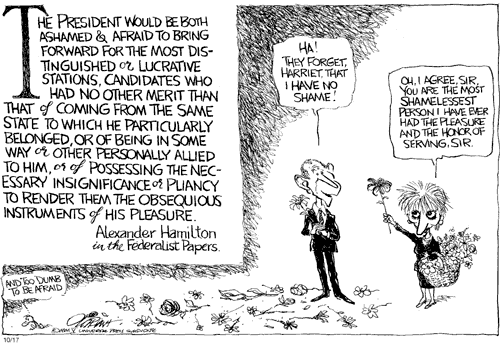
It's a little hard to read. To see it better, go here: Pat Oliphant Comics. It's from October 17.
I almost spewed my coffee the other day when I read that Harriet Miers thinks that President Bush is the most intelligent man she's ever met. If it's true, that is just tragic.
Odds are good that President Bush hasn't read The Federalist Papers, but I'll bet that someone in his office reads The Washington Post. Here's hoping that word gets back to him that the gloves are off out here in the cornfield.
Thanks to the long-suffering spouse for pointing this cartoon out to me.
Tags: activism
Saturday, October 22, 2005
Famous Too Late
Everybody's heard of her now. LaShaun Harris didn't take her medicine to control the symptoms of her schizophrenia, heard voices telling her to throw her children in the San Francisco Bay, and she did it. As far as I know, the bodies of two of the boys are still missing, but presumably all three children are dead.
For the record, I could probably go down in history as the biggest lover of children that ever lived. The idea of three dead children makes me want to howl at the moon in grief.
At the same time, though, I'm disturbed by the fact that the wharf is now turning into a little shrine. People are leaving flowers and other mementos in honor of the missing boys. Where were any of us when she was trying to raise those children, homeless, with a severe mental illness, and an abusive partner who admitted to the national news that he was violating the order of protection against him?
This kind of tragedy doesn't happen in a vacuum. There is a web of societal failures that culminated in this horrible day. Why does ANY 16 year old get pregnant? Why do we tolerate and wink at domestic violence? Why do orders of protection only work when they're violated -and then only sometimes? Why do we still not have anything other than the most primitive of drugs to control schizophrenic symptoms?
It's not that I'm a weak-minded bleeding heart liberal who only wants to divert blame from a murderous mother. To tell you the truth, I'm not terribly interested in whether or how much we blame the mother here. I do think feminist jurisprudence has fascinating and powerful points to make, but my interests are different. The only thing we can do now is learn something from this and prevent the next desperately ill and socially bereft mother from killing her children. And the questions raised by her actions are profound.
How do we ethically offer services to someone when the services we have are themselves so debilitating? Can we force a mentally ill mother to take her meds? Can we take her children into protective custody just because she's mentally ill? LaShaun Harris had -I'm pretty sure this is true- never hurt her children before. Child Protection clearly can't comment about that, but no one interviewed suggested that there had ever been child abuse before. Ought we force people to accept shelter?
These questions all have currently-legal answers, which may or may not be satisfactory to you. But the answers suggest to me that, even had LaShaun Harris become famous through some miracle before she drowned her children, we still might not have had anything substantive to offer her. We probably could have postponed this tragedy. We might even have been able to mitigate it a little. But we would just have replaced it with other tragic outcomes.
So, I suggest that we take at least one more step back. Why are the vast majority of people suffering from mental illness women? There's something a little facile about a society that systematically truncates women's experiences and devalues their contributions, then wrings its hands and frets that doing so has such drastic consequences. Although the impulse is good, we need to do a whole lot more than leave flowers at the wharf. First, we need to offer real, meaningful help to people who are mentally ill, before they cause and endure even more pain. Secondly, we have to create a just world where people don't have to face such abject powerlessness. It sounds grandiose and ridiculous, but that IS the project, or more people will become famous too late.
For the record, I could probably go down in history as the biggest lover of children that ever lived. The idea of three dead children makes me want to howl at the moon in grief.
At the same time, though, I'm disturbed by the fact that the wharf is now turning into a little shrine. People are leaving flowers and other mementos in honor of the missing boys. Where were any of us when she was trying to raise those children, homeless, with a severe mental illness, and an abusive partner who admitted to the national news that he was violating the order of protection against him?
This kind of tragedy doesn't happen in a vacuum. There is a web of societal failures that culminated in this horrible day. Why does ANY 16 year old get pregnant? Why do we tolerate and wink at domestic violence? Why do orders of protection only work when they're violated -and then only sometimes? Why do we still not have anything other than the most primitive of drugs to control schizophrenic symptoms?
It's not that I'm a weak-minded bleeding heart liberal who only wants to divert blame from a murderous mother. To tell you the truth, I'm not terribly interested in whether or how much we blame the mother here. I do think feminist jurisprudence has fascinating and powerful points to make, but my interests are different. The only thing we can do now is learn something from this and prevent the next desperately ill and socially bereft mother from killing her children. And the questions raised by her actions are profound.
How do we ethically offer services to someone when the services we have are themselves so debilitating? Can we force a mentally ill mother to take her meds? Can we take her children into protective custody just because she's mentally ill? LaShaun Harris had -I'm pretty sure this is true- never hurt her children before. Child Protection clearly can't comment about that, but no one interviewed suggested that there had ever been child abuse before. Ought we force people to accept shelter?
These questions all have currently-legal answers, which may or may not be satisfactory to you. But the answers suggest to me that, even had LaShaun Harris become famous through some miracle before she drowned her children, we still might not have had anything substantive to offer her. We probably could have postponed this tragedy. We might even have been able to mitigate it a little. But we would just have replaced it with other tragic outcomes.
So, I suggest that we take at least one more step back. Why are the vast majority of people suffering from mental illness women? There's something a little facile about a society that systematically truncates women's experiences and devalues their contributions, then wrings its hands and frets that doing so has such drastic consequences. Although the impulse is good, we need to do a whole lot more than leave flowers at the wharf. First, we need to offer real, meaningful help to people who are mentally ill, before they cause and endure even more pain. Secondly, we have to create a just world where people don't have to face such abject powerlessness. It sounds grandiose and ridiculous, but that IS the project, or more people will become famous too late.
Friday, October 21, 2005
Friday Random 10

Here's the game: take out your iPod and put it in Shuffle mode. Tell us the first ten songs that appear. And no fair adding songs that you think will make you look cool or leaving out the songs that make you look like a total dork. Here are mine for the week:
- Finlandia (live version); Indigo Girls (a total favorite!)
- Golden Cradle; Emmylou Harris
- Co-Dependent with you; The Chenille Sisters (ahem... dorkage!)
- Sangye; Kirby Shelstad
- Concerto No. 24 for Piano and Orchestra; Mozart
- Zydeco on the Bayou; Terrance Simien and the Mallett Playboys
- Ave Maria; Still Pointe (sung by a friend of mine!)
- Sweet Home Alabama; Lynyrd Skynyrd (for obvious reasons -being a displaced Southerner is a large part of my self-image)
- We Are the Ones; Sweet Honey in the Rock
- Me Myself I; Joan Armatrading
Tags: iPod
Thursday, October 20, 2005
A Heart-Broken Priest
Check out this open letter from a priest who's tried to fight the good fight: Leave of Absence Letter. Parts of it broke my heart. Part of it infuriated me (extra credit for those who guess that part). But mostly, I'm just worn out.
I have my issues with Voice of the Faithful. I'm close to the most anti-clerical Catholic I've ever known. It's not pretty or laudable, but there it is. And yet, I'm still moved by his letter -at least a little bit. I have more thinking to do on this subject, clearly. And I will, just as soon as I get back from a meeting. Hold me to it, please.
In the meantime, I just wanted to get this letter "out there" a little more. Let me know what you think.
Okay, I'm back. I don't know anything at all about this priest -the author of the letter- except for the clear fact that the hierarchy and its dissembling (to put it charitably, which they have NOT earned) re: the sex-abuse scandals have worn him to the bone. For that, he has earned some charity from me. I don't know how the good priests manage the day-to-day grind of their work environment.
And supporting those good priests is explicitly part of the mission of Voice of the Faithful. One might think that I'd be knocking down their doors. Their motto is "Keep the Faith. Change the Church". They want nothing spectacular -just a church that lives out its mission and where the priests don't prey on small children. Surely that's not threatening. And of course bishops are prohibiting them from meeting on church property. You'd think I'd be a member for that reason alone ;)
But I'm not a member, and I think, in part, it's because they would be satisfied with so little. Here's what I want, and I think I'm in good company.
Moreover, and here's where this gets controversial and I'm a little uncomfortable with my own argument.... I see no reason why even a church reform movement has to be priest-centered. Can't we think outside THAT box for just a tiny minute?
For a little while, I was willing to go into this crisis in the church with banners waving. I was willing to do what they taught me, to name injustice where I saw it and to work to change it. But this is far from the first time that I've tussled with the institutional church, and I've never won. Someone else is going to have to be the standard bearer on this one.
I don't feel defeated exactly -just unsurprised at this scandal and a little disturbed by the fact that other people are surprised. I'm certainly not bored with or indifferent to the suffering of individuals. But I'm a little indifferent towards the political machinations of the bureaucracy and the corresponding actions of the people hopeful of change. They (the hierarchs) have the church they worked for. This is the structure they worked to build and preserve. Until they're working to build and preserve something different, I guess they still want this one.
Even the good priests benefit from all the power and privileges that we allow priests -and which we, in large measure, pay for, by the way. So the good guys are out there, being pastoral and gentle, working for justice in third world countries and building homes with Habitat for Humanity, and occasionally remembering that women are part of God's creation and that feminine pronouns aren't swear words or heretical.... If only such a cleric would show up in my life.
And yet, what is he doing about changing the hierarchical church, which has allowed, condoned, winked at so much evil? When I see a little more of that -and this priest/author is at least giving it a shot- then perhaps I'll be a slightly less anti-clerical Catholic. And my hope in the unsettling Gospel that they preach will increase.
I have my issues with Voice of the Faithful. I'm close to the most anti-clerical Catholic I've ever known. It's not pretty or laudable, but there it is. And yet, I'm still moved by his letter -at least a little bit. I have more thinking to do on this subject, clearly. And I will, just as soon as I get back from a meeting. Hold me to it, please.
In the meantime, I just wanted to get this letter "out there" a little more. Let me know what you think.
Okay, I'm back. I don't know anything at all about this priest -the author of the letter- except for the clear fact that the hierarchy and its dissembling (to put it charitably, which they have NOT earned) re: the sex-abuse scandals have worn him to the bone. For that, he has earned some charity from me. I don't know how the good priests manage the day-to-day grind of their work environment.
And supporting those good priests is explicitly part of the mission of Voice of the Faithful. One might think that I'd be knocking down their doors. Their motto is "Keep the Faith. Change the Church". They want nothing spectacular -just a church that lives out its mission and where the priests don't prey on small children. Surely that's not threatening. And of course bishops are prohibiting them from meeting on church property. You'd think I'd be a member for that reason alone ;)
But I'm not a member, and I think, in part, it's because they would be satisfied with so little. Here's what I want, and I think I'm in good company.
A gospel that does not unsettle,
A word of God that does not get under anyone's skin,
A word of God that does not touch the real sin of the society in which it is being proclaimed.
What gospel is that?
- Archbishop Oscar Romero, April 16, 1978
Moreover, and here's where this gets controversial and I'm a little uncomfortable with my own argument.... I see no reason why even a church reform movement has to be priest-centered. Can't we think outside THAT box for just a tiny minute?
For a little while, I was willing to go into this crisis in the church with banners waving. I was willing to do what they taught me, to name injustice where I saw it and to work to change it. But this is far from the first time that I've tussled with the institutional church, and I've never won. Someone else is going to have to be the standard bearer on this one.
I don't feel defeated exactly -just unsurprised at this scandal and a little disturbed by the fact that other people are surprised. I'm certainly not bored with or indifferent to the suffering of individuals. But I'm a little indifferent towards the political machinations of the bureaucracy and the corresponding actions of the people hopeful of change. They (the hierarchs) have the church they worked for. This is the structure they worked to build and preserve. Until they're working to build and preserve something different, I guess they still want this one.
Even the good priests benefit from all the power and privileges that we allow priests -and which we, in large measure, pay for, by the way. So the good guys are out there, being pastoral and gentle, working for justice in third world countries and building homes with Habitat for Humanity, and occasionally remembering that women are part of God's creation and that feminine pronouns aren't swear words or heretical.... If only such a cleric would show up in my life.
And yet, what is he doing about changing the hierarchical church, which has allowed, condoned, winked at so much evil? When I see a little more of that -and this priest/author is at least giving it a shot- then perhaps I'll be a slightly less anti-clerical Catholic. And my hope in the unsettling Gospel that they preach will increase.
Tags: Catholicism
House Un-American Activities Committee

On this day, in 1947, the House of Representatives opened public hearings into alleged Communist influence in the motion picture industry. In response, a group of actors formed the Committee for the First Amendment. To read more about the CFA, go here: CFA. It's not, unfortunately, all that well-written an article, but it is informative. So, plow through it if you can; it's worth it.
Here's why I mention this today. I honestly think/fear that we're at another spot in history where we're in danger of becoming our own worst enemy. We are the greatest threat to democracy -or in danger of becoming that, to avoid over-stating my case.
But one thing that the investigation into the film industry teaches us is that we're all given a unique place to make a difference in the world. We don't choose it; it comes to us. These actors and directors just wanted to make movies, for heaven's sake. Or they wanted to be wealthy stars, or whatever.... They had a different plan for how their lives were going to play out. But they were pushed into activism and some of them accepted it splendidly. Gordon Kahn, the screenwriter for The African Queen, wrote this in a letter to his wife, about the HUAC's demand that he identify colleagues involved with the Communist party:
If now, in full flight from any principle I possess, I went and recanted everything and every decent thing I believe in, it wouldn't be enough. They'd want to know 'Who else? Now that you are purged who else? Give us names, dates and places!' Do you think I could live with myself for a minute after I did a thing like that? Or with you? Or could face my children? If this is a decent world when they grow up, they'd spit on me and be perfectly justified in doing so... No. I've got to hang on to something and if I can't be the most prosperous writer, I want to be able to hold my head up among the people of America and the world.
Leave aside the obvious fact that I wish there were screenwriters of such literacy working today. I'm still impressed. And as much as I'd like to think I'm mostly influenced by... you know.... (insert solemn voice here) THINKERS, there is something to be learned here. Do the next right thing. Do it over and over. It is not given to me to effect huge global change, but I can make my little corner of the world better and more just.
It's just that doing that isn't entirely consistent with the plan I thought I had for my life. Oh well.
Thanks to the Peace Calendar for the substantive information in this post. The homiletics are mine ;)
Tags: activism
Wednesday, October 19, 2005
Here we go again - more proposed budget cuts
This issue is important and urgent.
Thursday morning, the House of Representatives is considering a proposal to cut up to $50 billion from basic services to the poor: health care, nutrition, and education services. They are spinning this as necessary because of the high cost of rebuilding after Hurricane Katrina. Yet, the same revised budget has $70 billion in tax cuts, mostly for the wealthy.
How can I spin this as anything other than cruel and shameful behavior? I seriously can't think of a single explanation where this comes out as the sensible and ethical decision. Please, please take a minute to drop your Representative a line.
If you want more information before writing, here's some:
New York Times article. You'll need a free subscription.
Washington Post article. Again, you'll need a subscription.
But really, if you're inclined to help, you need to do it today.
Thursday morning, the House of Representatives is considering a proposal to cut up to $50 billion from basic services to the poor: health care, nutrition, and education services. They are spinning this as necessary because of the high cost of rebuilding after Hurricane Katrina. Yet, the same revised budget has $70 billion in tax cuts, mostly for the wealthy.
How can I spin this as anything other than cruel and shameful behavior? I seriously can't think of a single explanation where this comes out as the sensible and ethical decision. Please, please take a minute to drop your Representative a line.
If you want more information before writing, here's some:
New York Times article. You'll need a free subscription.
Washington Post article. Again, you'll need a subscription.
But really, if you're inclined to help, you need to do it today.
My Own Banned Books
A librarian friend sent me the ALA's list of the 100 most frequently banned or challenged books from 1990-2000. Here it is, if you're interested: Banned Books. (I'd only read something like 25 of them.) Some of the books really are reprehensible. Hello? Little Black Sambo??!! So, the issue of banning books has been on mind.
Then I hear that Starbucks plans to have a quote from The Purpose-Driven Life on its cups this spring. They've made other provocative choices in this quotes-on-the-cups campaign, so this time it's just my turn to get my chain pulled, I suppose. But I hate that book. My resolution of these two separate trains of thought is that it's all right for ME to ban books. And since no one has offered me the position of "queen of the universe" with full powers to get others to do my bidding (a clear oversight on the part of the universe, but we'll get to that later), I only get to ban books in my own house. This one heads the still-forming list.
Book clubs everywhere, it seemed, were reading it, so I bought it. I couldn't make myself finish it. Trivial, demeaning, saccharine.... gosh, Andrea, tell us what you really think! Which is a shame, since I want a purpose driven life. In many ways, that's why I have this blog. Moreover, my faith is important to me. So wouldn't you think I'd love that book? Wouldn't you think I was the target audience?
Apparently not. For one thing, the author seemed awfully interested in selling me his other products. I guess if you're going to find your life's purpose in 40 days, you're going to need tools. Sloppy hermeneutics and sloppier psychological trivializations made me want to throw the book across the room. (I sold it on half.com instead.) What's weirder yet is that it's mostly neo-conservatives making these exact arguments.
Perhaps most liberals knew better than to buy the book in the first place. This wouldn't be the first time I'd fallen into the "naively hopeful" camp. Nonetheless, I was hoping for, at the very least, a critique from the intellectually-rigorous, religiously-liberal side of the aisle. I'd do one myself, but I didn't finish the book. Whoops. Even better would be a guide to exactly the same thing from that perspective. It's probably true, as I suspected and feared, that I just have to do that myself, as well.
Sigh....
Then I hear that Starbucks plans to have a quote from The Purpose-Driven Life on its cups this spring. They've made other provocative choices in this quotes-on-the-cups campaign, so this time it's just my turn to get my chain pulled, I suppose. But I hate that book. My resolution of these two separate trains of thought is that it's all right for ME to ban books. And since no one has offered me the position of "queen of the universe" with full powers to get others to do my bidding (a clear oversight on the part of the universe, but we'll get to that later), I only get to ban books in my own house. This one heads the still-forming list.
Book clubs everywhere, it seemed, were reading it, so I bought it. I couldn't make myself finish it. Trivial, demeaning, saccharine.... gosh, Andrea, tell us what you really think! Which is a shame, since I want a purpose driven life. In many ways, that's why I have this blog. Moreover, my faith is important to me. So wouldn't you think I'd love that book? Wouldn't you think I was the target audience?
Apparently not. For one thing, the author seemed awfully interested in selling me his other products. I guess if you're going to find your life's purpose in 40 days, you're going to need tools. Sloppy hermeneutics and sloppier psychological trivializations made me want to throw the book across the room. (I sold it on half.com instead.) What's weirder yet is that it's mostly neo-conservatives making these exact arguments.
Perhaps most liberals knew better than to buy the book in the first place. This wouldn't be the first time I'd fallen into the "naively hopeful" camp. Nonetheless, I was hoping for, at the very least, a critique from the intellectually-rigorous, religiously-liberal side of the aisle. I'd do one myself, but I didn't finish the book. Whoops. Even better would be a guide to exactly the same thing from that perspective. It's probably true, as I suspected and feared, that I just have to do that myself, as well.
Sigh....
Tuesday, October 18, 2005
Privacy???
How I got to these thoughts is a long muddled story.
Step one: The long-suffering spouse had a skin cancer removed from his eyelid yesterday. In the course of that, he had to sign the privacy protection document that we've all been signing for a few years now. Signing and not reading, of course. The document spells out, presumably accurately, to whom the provider can release your health information. It included Homeland Security, in the interest of national security, and to law enforcement officials for the protection of the president.
Now how on earth is my health information going to be useful in protecting the president? And how far are they willing to go to protect him? One doesn't have to think very long before coming up with absurd -but alarmingly possible- examples of how this might be used. Should HIV-positive individuals be barred from presidential appearances, lest they bleed on him? How about people with a history of mental illness? How mentally ill is mentally ill enough and who gets to decide that?
Step two: Yet another NPR story has me musing on a related privacy issue. Arlan Specter originally claimed that Harriet Miers believed the Constitution does provide a right to privacy. He has since, however, retracted his statement, apparently at the White House's behest. Now he says he must have misinterpreted her remarks.
The case that she was asked about was Griswold v. Connecticut, from 1965. I'm not a lawyer, and this is very far from my area of expertise. But I am literate, and it sure looks to me like Connecticut had criminalized any use at all of contraception. It doesn't require a very robust definition of privacy to realize that such a law has no possibility of being enforced and needs to be struck down.
Which is what the court did. And Harriet Miers either thinks this case was rightly decided or she doesn't. Arlan Specter isn't sure and therefore we're not sure.
Two questions naturally arise. Why was she being asked to comment on such a minimalist definition of privacy? Surely we can do better than that. And why this case in particular? Please tell me that we aren't headed back to a political climate where contraception is illegal or circumscribed. Are we?
My poorly-though-out position on privacy has always been that my life is an open book. If the FBI wants to get my patron records from the public library (to save you time, I check out books about yoga, cooking, knitting, religiosity, with the occasional summer-time nosedive into chicklit) or Homeland Security wants my health records (terrible allergies, by the way) then at least they're occupied and not doing something more destructive. But hold on just a cotton-pickin' minute here.
The confluence of these two completely unrelated experiences has me worried. When you add in the surreal Indiana proposal to require a permit -and a wedding- before allowing in vitro fertilization, it doesn't take a genius to notice that this could get weird and dangerous fast.
So, assuming I'm not wringing my hands over nothing, where do we go from here? All I can think of harkens back to yesterday's post. Those of us who aren't card-carrying members of the ACLU might need to consider it. There's a Constitution to protect here. Or make me another suggestion. I'm all ears.
Step one: The long-suffering spouse had a skin cancer removed from his eyelid yesterday. In the course of that, he had to sign the privacy protection document that we've all been signing for a few years now. Signing and not reading, of course. The document spells out, presumably accurately, to whom the provider can release your health information. It included Homeland Security, in the interest of national security, and to law enforcement officials for the protection of the president.
Now how on earth is my health information going to be useful in protecting the president? And how far are they willing to go to protect him? One doesn't have to think very long before coming up with absurd -but alarmingly possible- examples of how this might be used. Should HIV-positive individuals be barred from presidential appearances, lest they bleed on him? How about people with a history of mental illness? How mentally ill is mentally ill enough and who gets to decide that?
Step two: Yet another NPR story has me musing on a related privacy issue. Arlan Specter originally claimed that Harriet Miers believed the Constitution does provide a right to privacy. He has since, however, retracted his statement, apparently at the White House's behest. Now he says he must have misinterpreted her remarks.
The case that she was asked about was Griswold v. Connecticut, from 1965. I'm not a lawyer, and this is very far from my area of expertise. But I am literate, and it sure looks to me like Connecticut had criminalized any use at all of contraception. It doesn't require a very robust definition of privacy to realize that such a law has no possibility of being enforced and needs to be struck down.
Which is what the court did. And Harriet Miers either thinks this case was rightly decided or she doesn't. Arlan Specter isn't sure and therefore we're not sure.
Two questions naturally arise. Why was she being asked to comment on such a minimalist definition of privacy? Surely we can do better than that. And why this case in particular? Please tell me that we aren't headed back to a political climate where contraception is illegal or circumscribed. Are we?
My poorly-though-out position on privacy has always been that my life is an open book. If the FBI wants to get my patron records from the public library (to save you time, I check out books about yoga, cooking, knitting, religiosity, with the occasional summer-time nosedive into chicklit) or Homeland Security wants my health records (terrible allergies, by the way) then at least they're occupied and not doing something more destructive. But hold on just a cotton-pickin' minute here.
The confluence of these two completely unrelated experiences has me worried. When you add in the surreal Indiana proposal to require a permit -and a wedding- before allowing in vitro fertilization, it doesn't take a genius to notice that this could get weird and dangerous fast.
So, assuming I'm not wringing my hands over nothing, where do we go from here? All I can think of harkens back to yesterday's post. Those of us who aren't card-carrying members of the ACLU might need to consider it. There's a Constitution to protect here. Or make me another suggestion. I'm all ears.
Monday, October 17, 2005
A Proud -and Worried- Bleeding Heart Liberal
You know how conservatives "accuse" us of being "card-carrying members of the ACLU" as though that were a bad thing? And our confused response is "Of course, I'm a member of the ACLU (although I have no idea where my card is)". The same thing happens with "bleeding heart liberal."
I woke up this morning to an NPR story about how children are the most vulnerable victims of the earthquake in Pakistan. Welcome to the world of social work. Children are almost always the most vulnerable victims of anything bad. That's why they're supposed to have grown-ups to take care of them. Here's the story: Youngest Survivors
The upshot of it is this. There are young children, alive now but who will undoubtedly die of exposure in the next few days. They will die alone, in pain, hungry, and afraid. The intellectual (such as it is) part of me is still awake. And I ponder how on earth to mount an effective disaster response when there's no infrastructure for doing that -or not much, anyway. How do you reunite separated family members when there's very little recorded data as to who lived with whom in the first place?
But mostly my heart just bleeds for those children. That's what hearts are supposed to do.
I woke up this morning to an NPR story about how children are the most vulnerable victims of the earthquake in Pakistan. Welcome to the world of social work. Children are almost always the most vulnerable victims of anything bad. That's why they're supposed to have grown-ups to take care of them. Here's the story: Youngest Survivors
The upshot of it is this. There are young children, alive now but who will undoubtedly die of exposure in the next few days. They will die alone, in pain, hungry, and afraid. The intellectual (such as it is) part of me is still awake. And I ponder how on earth to mount an effective disaster response when there's no infrastructure for doing that -or not much, anyway. How do you reunite separated family members when there's very little recorded data as to who lived with whom in the first place?
But mostly my heart just bleeds for those children. That's what hearts are supposed to do.
Subscribe to:
Posts (Atom)